
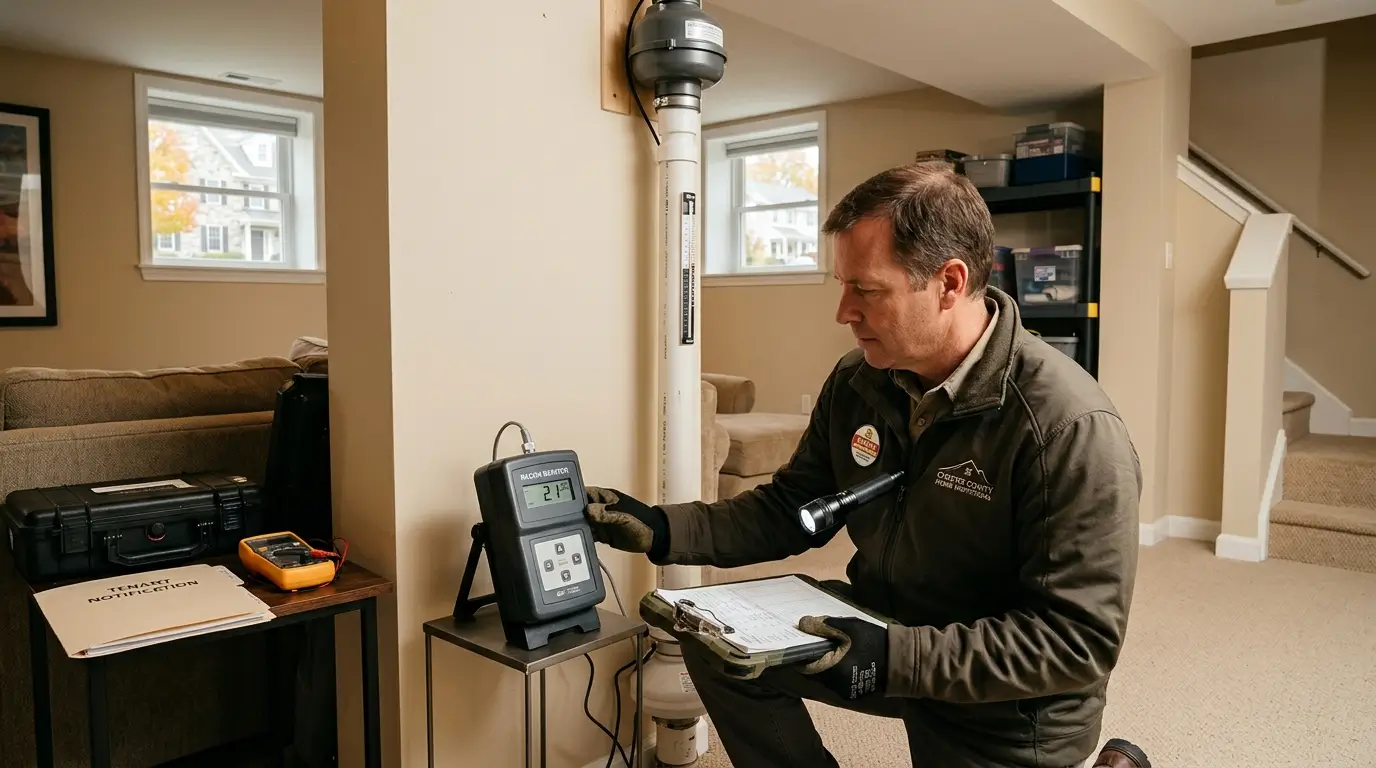
Radon is invisible, odorless, and unusually common in Pennsylvania. DEP’s radon program manager has called the state probably the most radon-prone in the country, and EPA places Chester County in its highest-potential zone. Pennsylvania doesn’t currently require landlords to test a rental, but EPA tells renters to ask their owner to do it, and a bill in Harrisburg would change the rules. Here’s how to handle radon before a tenant asks.
Key Takeaways
EPA’s radon zone map places Chester County in Zone 1, its highest category, and EPA says all homes should be tested regardless of zone.
EPA’s action level is 4 pCi/L, and EPA recommends considering a fix between 2 and 4.
A Pennsylvania Senate memo says there is currently no requirement for landlords to test, and Senate Bill 497, which would address rentals, has been in committee since March 2025.
DEP certification is required to test or mitigate radon for others, with an exemption for a person testing a building they own or occupy.
EPA’s tenant guide tells renters to ask owners to test, so expect the question and answer it with a report.
Why Radon Matters Here
EPA’s map of radon zones defines Zone 1 as counties with a predicted average indoor screening level above 4 pCi/L, and it places Chester County there. EPA also says all homes should be tested regardless of zone, since levels vary from house to house. The stakes are health ones: EPA calls radon the number one cause of lung cancer among non-smokers, responsible for about 21,000 lung cancer deaths a year. A Pennsylvania Senate co-sponsorship memo estimates that about 40 percent of the state’s homes exceed 4 pCi/L, and a companion House memo notes that all 67 counties have recorded tests above the action level. Reporting on DEP’s advice adds that testing is recommended in rental homes too.
What the Law Requires, and What It Doesn’t
Pennsylvania’s radon law is built around certification, not rental testing. Under the Radon Certification Act and 25 Pa. Code Chapter 240, DEP certification is required to test, mitigate, or analyze radon for anyone other than the building owner, with an exemption for testing or mitigating a building the person owns or occupies. For a landlord, that means you may test your own rental, but a handyman, inspector, or manager placing and retrieving devices needs certification. A DEP-certified tester also gives you a report that holds up if a tenant or buyer ever asks.
There is no rental testing mandate yet. The Senate memo says plainly that there is currently no requirement for landlords to test. Senate Bill 497 would provide for radon testing and remediation in school buildings, residential buildings, and other structures, and its sponsor’s office describes it as covering all residential rental properties. According to the General Assembly’s bill page, its last recorded action is referral to committee on March 21, 2025. That could change, so it’s smart to build the habit now. This is general information, not legal advice.
How to Test
EPA’s guide for tenants lays out the basics: short-term tests run from two days to 90 days, long-term tests run more than 90 days, and a short-term result at or above 4 pCi/L should be followed by a second test. For a rental, the practical sequence is a short-term test by a certified tester in the lowest livable level, then a follow-up if the result is at or above 4. The best moment is turnover, when the unit is empty, the house can be kept closed under test conditions, and no tenant’s schedule is disrupted. If a tenant is still in place, give notice that testing is coming and ask them to keep windows and exterior doors closed for the test period, since open windows can skew a short-term result. Keep the lab report, the tester’s certification number, the placement location, and the dates in the property file.
Fixing a High Result
EPA says to fix your home at 4 pCi/L or higher and consider fixing between 2 and 4. Mitigation, usually a sub-slab system with a fan and vent pipe, should be done by a DEP-certified mitigator, and EPA’s tenant guide has put the cost of radon reduction at roughly $500 to $2,500 for a single-family home, though current quotes may run higher. Ask for a written scope of work and warranty before anything starts, confirm the contractor’s DEP certification before you sign, and get the installer’s documentation and a post-fix test, then keep both. Pennsylvania’s mitigation standards also call for a system label that includes a reminder to test the building at least every two years, a sensible rhythm for rentals.
Talking to Tenants
Expect the question. EPA’s Radon Guide for Tenants tells renters that if their building hasn’t been tested, they can ask the owner to test or test it themselves, and it notes that over one-third of U.S. housing units are rentals. The easiest way to handle it is to get ahead of it. Add a short radon notice to your move-in packet that states the test date, the result, and any mitigation done, and link EPA’s tenant guide. If a result is elevated, say what you’ve done and when, rather than minimizing it. If a tenant brings you their own result, take it seriously and confirm it with a certified test. Written, dated communication protects both sides, and our rent-ready checklist for Chester County landlords is a natural place to add the radon step.
Build It Into Turnover
Radon testing fits the routine you already follow at turnover. Schedule the test during the vacancy, record results alongside your photos and move-in condition report, calendar a retest every two years, and budget for mitigation as a possible cost. The same logic applies to routine inspections: small, scheduled checks cost far less than discovering a problem later.
FAQ
Is Chester County a high-radon area?
EPA’s radon zone map places it in Zone 1, its highest category, but only a test shows a specific home’s level.
Are Pennsylvania landlords required to test for radon?
A January 2025 Senate memo says there is currently no requirement, and Senate Bill 497, which would address rentals, was referred to committee in March 2025.
Can I test my own rental property?
DEP’s rules exempt a person testing a building they own or occupy. Anyone else who tests or mitigates must be DEP-certified.
What radon level calls for action?
EPA recommends fixing at 4 pCi/L or higher and considering a fix between 2 and 4.
Test Before Someone Asks
In a county EPA places in its highest radon zone, a documented test is one of the simplest ways to show tenants you take their health seriously. If you’d like help working radon testing into the move-in and move-out inspections and documentation we already handle, our Chester County property management team can help you build it into your turnover process.